
NEW REPORT: Cyber failings of Australian boards. Download the report here

Home | Board Effectiveness Framework

Your board effectiveness roadmap

The 20 validated categories of board effectiveness using the WhatWhoHowDo Framework

The WhatWhoHowDo Framework

Our Board Effectiveness Survey is built on the internationally recognised WhatWhoHowDo Framework, a model designed to assess how boards function in practice — not just in theory.

In early 2020, the framework underwent comprehensive refinement in collaboration with Deakin University in Melbourne. This review established psychometrically robust and defensible dimensions of board performance, drawing on extensive empirical data and contemporary governance research. The result is a validated, world-class board effectiveness survey grounded in evidence rather than assumption.

Few board frameworks have been subjected to this level of academic scrutiny. Rigorous validation requires substantial data — typically drawn from hundreds of board reviews — which many review providers have not accumulated. The WhatWhoHowDo refinement process was informed by a significant body of board data, ensuring both reliability and relevance.

Through this analysis, 20 distinct factors were identified as the most critical indicators of board effectiveness. These factors form the foundation of our survey, providing boards with structured, credible insight into how effectively they are governing and where improvement will have the greatest impact.

Download the Board Effectiveness Framework

PDF 473kb
Download


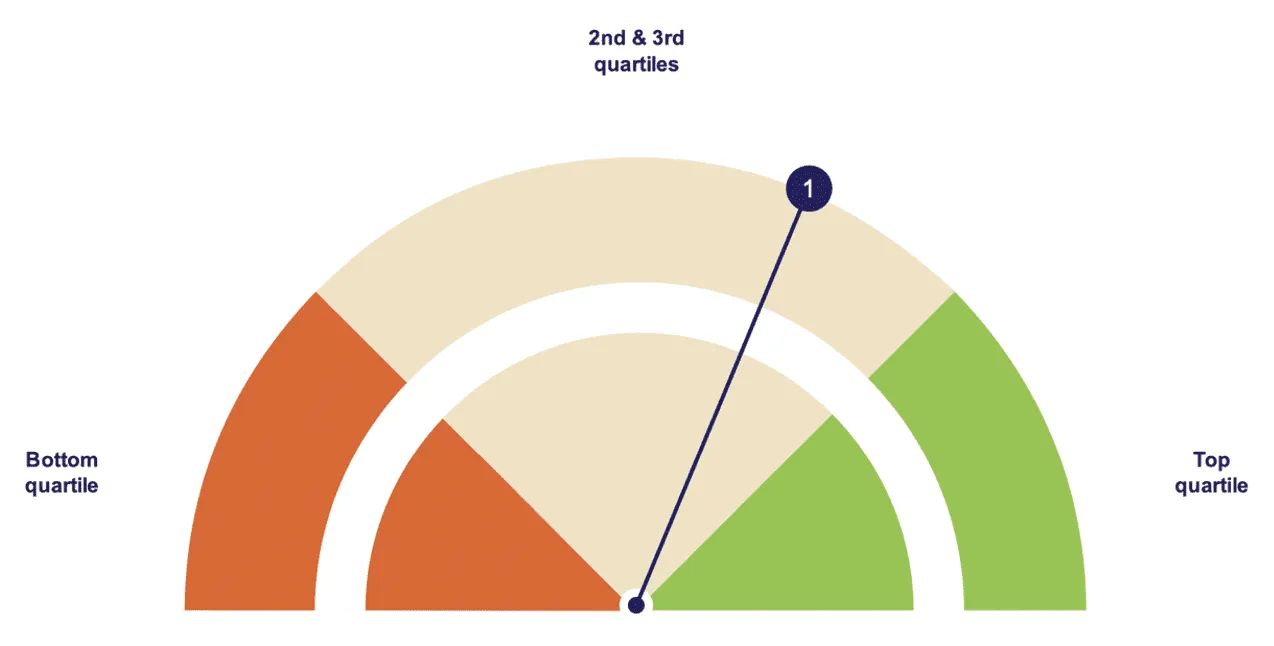
Each board’s effectiveness is first benchmarked against boards of comparable organisations, as shown below.
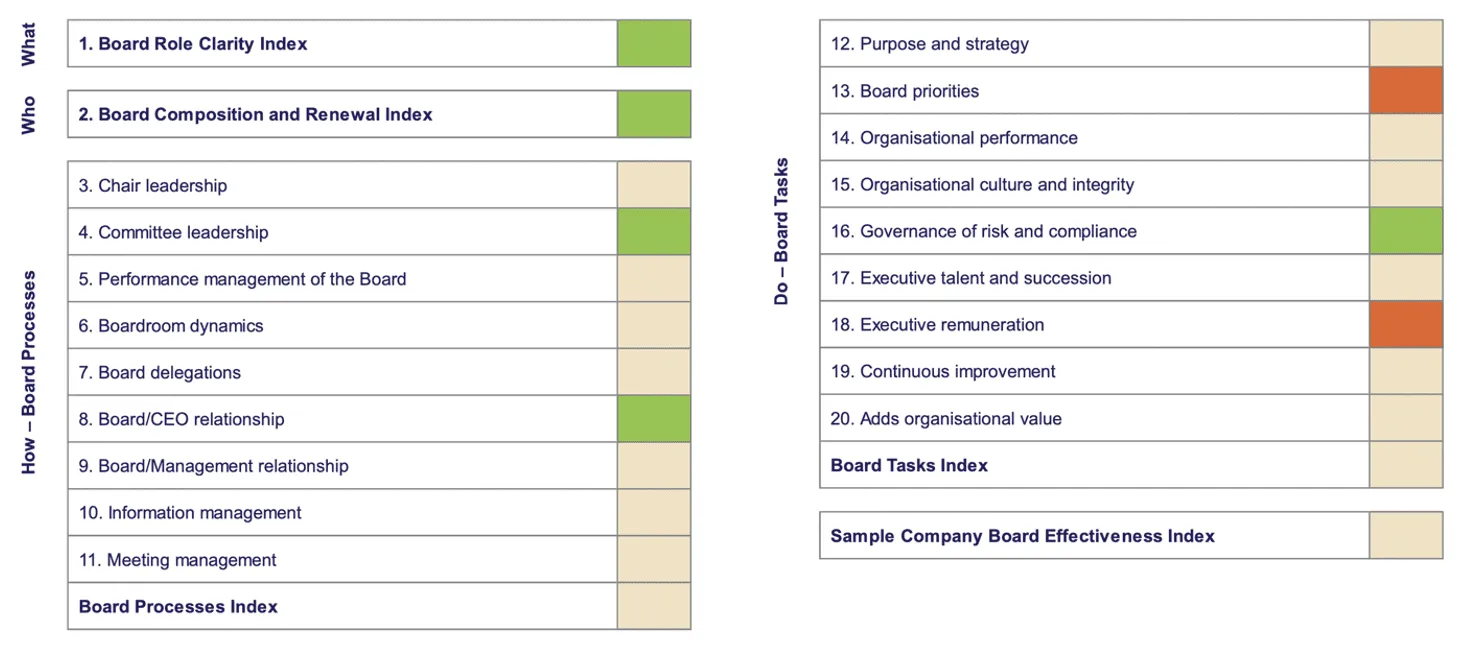
Each board is also benchmarked in relation to the 20 most important dimensions for a board’s effectiveness, as shown in the example below.
Each survey item comprising each of the 20 dimensions is benchmarked, as shown in our sample report.

Many clients tell us that our benchmarking makes all the difference! They say if our benchmarking colours were removed, interpreting our reports would be much more difficult. Our report design and use of benchmarking make our report intuitive and easy to understand. ‘Hot spots’ are highlighted very quickly and easily.

The 20 most important categories of a board’s effectiveness are explained in detail below. 

WHAT – Board clarity – ie. adding role

An effective board starts with clear role definitions. Directors must understand how their responsibilities differ from management’s, reinforced through up-to-date board and committee charters. Clarity of roles reduces confusion, prevents overreach, and builds a strong foundation for accountability, collaboration, and good governance at both strategic and operational levels.

WHO – Board composition and renewal

A high-functioning board is built intentionally. This includes a thoughtful blend of skills, experiences and perspectives, underpinned by robust succession planning. Proactive recruitment, structured inductions, and a regular skills matrix review ensure that the board evolves alongside the organisation and remains capable of meeting emerging challenges.

HOW – Board processes

The Chair’s leadership is foundational. An effective Chair sets the tone, fosters healthy debate, and ensures the board remains focused on strategic outcomes. They guide decision-making with sound judgement, manage dissent respectfully, and act as a bridge between the board and management to promote cohesion and momentum.

Committees only work when their leadership is strong. Chairs must set clear expectations, lead with purpose, and communicate insightfully with the board. They also need to work productively with management, ensure committee work adds value, and provide structured reports that feed directly into effective board deliberation and decisions.

Boards must hold themselves to account. Regular evaluation of individual and collective effectiveness helps surface blind spots and reinforce a high-performance culture. Boards should address underperformance early, provide developmental feedback, and ensure the Chair and committee leaders are also assessed in a structured and meaningful way.

Boards are most effective when they work as a team. Constructive dynamics allow disagreement without discord and encourage inclusive, respectful dialogue. Creating a psychologically safe environment — where directors can challenge ideas without fear of criticism — is key to unlocking innovation and better decision-making around the board table.

The boundaries between board and management should be well understood. Clear, up-to-date delegations support faster decisions and reduce ambiguity. Both directors and executives must understand what matters require board input, and where autonomy exists, to promote trust, reduce bottlenecks, and ensure decisions are made at the right level.

A productive Chair-CEO relationship is collaborative, transparent, and grounded in mutual respect. While the board supports the CEO, it must remain independent and provide rigorous oversight. Effective performance review processes and open communication help strengthen trust and alignment on vision, strategy, and leadership priorities.

Strong governance is built on a foundation of mutual trust and open dialogue between the board and management. Boards should challenge and support management thinking, while providing direction and feedback. Management, in turn, must feel confident in raising concerns early and engaging the board in critical conversations.

Boards depend on timely, forward-looking, and well-curated information to govern effectively. Management should provide strategic insights — not just operational data — that enable informed oversight and decision-making. Responsiveness to information requests, clarity in presentation, and proactive issue flagging are all essential to good board information flow.

Board meetings should be purposeful, efficient, and strategically focused. Management presentations must be concise and additive, not repetitive. Effective meeting management includes structured agendas, strong facilitation, timely follow-ups, and space for board-only discussions that promote candour, reflection, and alignment on sensitive or complex matters.

DO – Board tasks

Boards must steer strategy while ensuring alignment with the organisation’s mission and values. This involves rigorous engagement with the strategic planning process, a solid understanding of performance drivers, and the ability to sense and respond to emerging risks and opportunities in the broader external environment.

Time is a board’s most limited resource. High-performing boards actively shape their annual agendas to prioritise big-picture issues. They conduct regular strategic deep dives, track progress on core goals, and ensure that governance activities are aligned with the organisation’s most pressing long-term success factors.

Boards drive performance by setting expectations, ensuring strong accountability, and fostering a culture of achievement. They monitor the effectiveness of performance systems, review KPIs rigorously, and take early action when results lag. Celebrating wins and supporting continuous improvement are also vital to sustaining high performance.

Culture isn’t intangible — it’s shaped through oversight, leadership, and governance. Boards must set clear expectations around ethics, ensure mechanisms exist for managing conflicts, and ensure stakeholder relationships are managed well. A board that actively engages with culture can strengthen integrity, inclusion, and resilience across the organisation.

The board plays a crucial role in ensuring the organisation is crisis-ready and risk-smart. This includes overseeing risk appetite, internal controls, and compliance systems. Regular updates and scenario planning, particularly on issues like cybersecurity and regulatory change, help boards stay proactive and protect long-term sustainability.

Succession planning is not just about the CEO but about ensuring depth of leadership talent. Boards must identify and nurture future talent, oversee development strategies, and ensure contingency plans are in place. Their involvement helps secure continuity and organisational capability in times of transition.

Executive pay should reflect performance, market conditions, and the organisation’s strategic goals. Boards must ensure pay structures are well-documented, fair, and aligned with desired behaviours. This includes overseeing non-CEO executive pay to maintain consistency and avoid reputational or cultural risks associated with poorly structured incentives.

An effective board never rests on its laurels. Regular self-reflection, openness to feedback, and a commitment to adapt are hallmarks of a learning board. Directors should remain curious, engage in professional development, and embrace new ideas to keep pace with governance best practice and sector trends.

The most effective boards are value creators, not just overseers. Their contributions are evident in improved strategy execution, stronger leadership, and enhanced reputation. Boards should regularly ask: “Are we making a difference?” If the answer is yes, then governance is not just good — it’s impactful.

Considering a Board Effectiveness Review?

We help you determine the right approach — from a lighter-touch benchmark review to a tailored, deeper-dive design. Our team works with you to match the review to your board’s context and needs.

Transform oversight 
into impact

Connect with us today and turn good governance into great outcomes.
Insync Boards acknowledges the Traditional Custodians of the land where we work and live. We pay our respects to Elders past, present and emerging and extend that respect to all Aboriginal​ and Torres Strait Islander Peoples.

Board Benchmarking
Australia

Level 27, 367 Collins Street

Melbourne, Victoria 3000
PH: +61 3 9909 9295

Westlake Governance
New Zealand
PO Box 8052
Wellington 6140
New Zealand
PH: +64 21 443 137

Halex Consulting
United Kingdom
86-90 Paul Street London, EC2A 4NE
PH: +44 (0)20 3823 6569

Cornerstone
India

313 Gokul Arcade
Subhash Road,
Vile Parle East
Mumbai, 400057 
PH: +91 981 907 7135

Peakstone Global
Australia
GPO Box 1486
Brisbane Queensland 4001
PH: 1300 860 450

Board Benchmarking
Malaysia
66 Jalan Ibrahim Johor Bahru
80000 Johor
PH: +60 1933 54731

BDO
Mauritius
10 Frère Félix de Valois
Port Louis
PH: +230 202 3000

Gaines Advisory
Australia
PO Box 610
Cottesloe WA 6011
PH: +61 414 633 230

BDO
Malaysia
360 Jalan Tuanku Abdul
Rahman
50100 Kuala Lumpur
PH: +603 2616 2888

Twafiika Consultants
Africa
20 Eugmbo Street
Windhoek

Namibia
PH: +264 81 287 2104

© Copyright 2005 - 2026 Insync Boards
Privacy Policy Terms & Conditions