
Try a FREE Board Survey and get a Benchmarked Report - Click Here

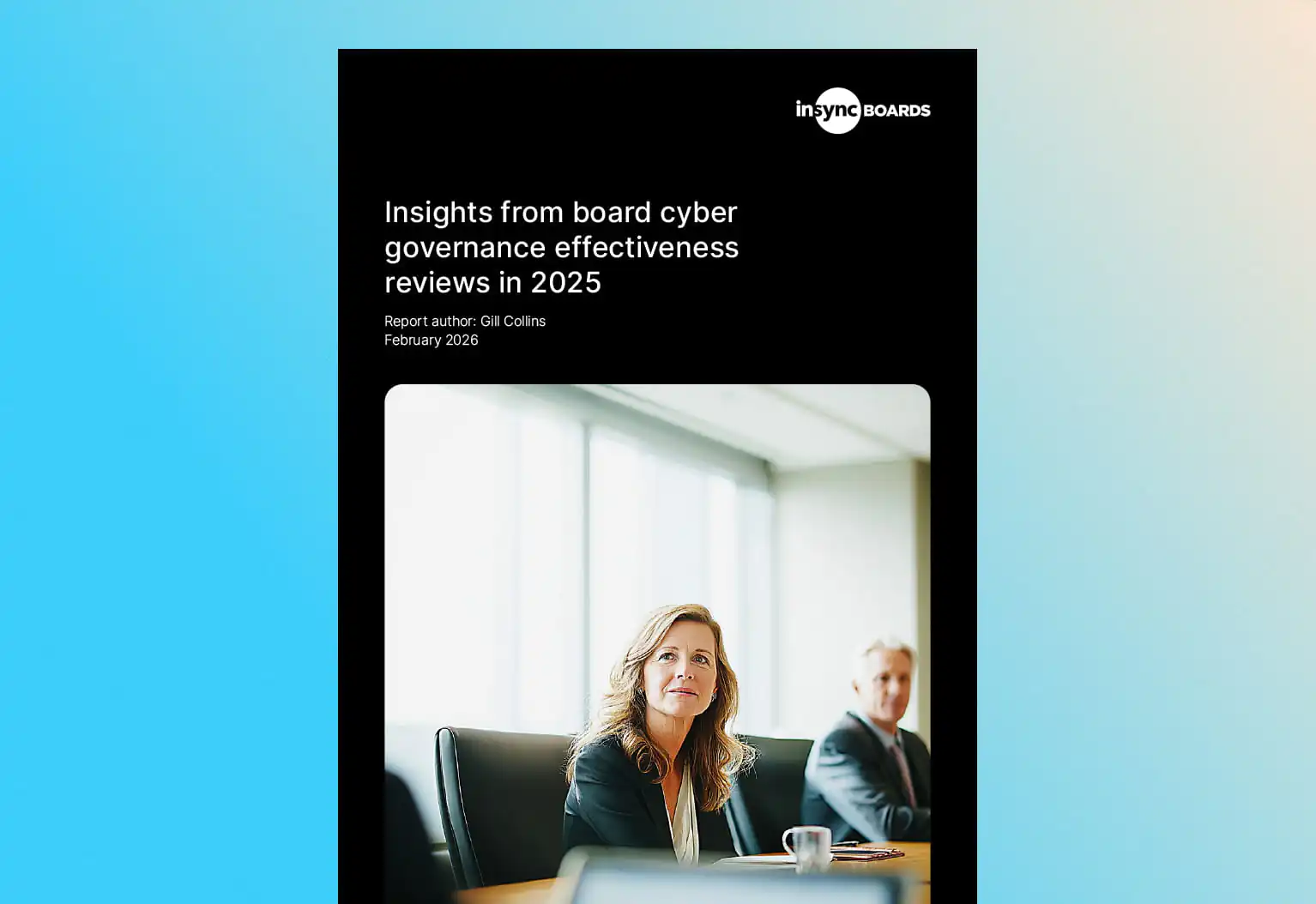
Australian directors now sit on the front line of cyber risk governance, with regulators making it clear that “hoping for the best” is no longer a defensible strategy. The question is no longer whether boards are responsible for cyber, but whether they can demonstrate competent, continuous oversight of it.
ASIC, APRA and government cyber agencies have steadily reframed cyber from an IT issue to a core governance and director‑duty issue. ASIC explicitly expects directors to ensure their organisation’s risk management framework adequately addresses cyber risk and that controls are fit for purpose. APRA’s CPS 234 goes further for regulated entities: the board is ultimately responsible for information security and must ensure it is commensurate with the size of the institution and the threats it faces. The Australian Cyber Security Centre and AICD’s Cyber Security Governance Principles now set a de facto benchmark for better‑practice board oversight that investors and regulators increasingly look to.
The FIIG outcome shows these expectations are not theoretical. The AU$2.5 million civil penalty, plus costs and court‑ordered cyber uplift, demonstrates that prolonged, obvious cyber weaknesses are now treated as governance failures, not mere technical shortcomings. For any board, the message is stark: if your controls and oversight resemble FIIG’s past posture, you are in the enforcement risk zone.
Cyber risk now sits firmly within traditional duties to act with care and diligence, to act in good faith, and to ensure the company has adequate risk systems and controls. ASIC has made clear through speeches and enforcement that directors cannot abdicate cyber responsibility any more than they can delegate financial or safety oversight and then look away. Recent and foreshadowed cases show that boards who treat cyber as a technical black box, under‑resourced and rarely challenged, may face personal and corporate consequences when an incident exposes those weaknesses.
FIIG makes this concrete. The failings ASIC described—over multiple years—were not exotic: slow or absent patching, weak access controls, inadequate monitoring, limited training, and an untested incident response capability. These are basic hygiene measures that any reasonably informed board should recognise and demand. When they are missing or persistently deferred, regulators now see that as a failure of governance oversight, not just an operational lapse.
In practice, this means directors must be able to show they understand their organisation’s key cyber exposures, ask informed questions, and test management’s assurances rather than simply relying on optimistic dashboards. Where boards lack in‑house expertise, they are expected to seek external advice or strengthen their composition, while always remaining accountable for the decisions that follow. FIIG underlines that “we did not fully understand the risk” is not a defence; it is evidence that governance was not where it needed to be.
For APRA‑regulated entities, CPS 234 and its companion guidance put the board at the centre of information security governance. Boards must:
ASIC, for its part, has moved decisively from guidance to enforcement. It has warned that cyber must be a top priority for all boards, with particular focus on third‑party vulnerabilities and continuous uplift of controls, not one‑off projects. FIIG follows earlier actions (such as RI Advice) and amplifies them: where an organisation’s cyber maturity is clearly below contemporary expectations, and that persists over time, ASIC will argue that licence obligations and governance standards have been breached.
For directors, FIIG adds three sharp edges: the size of the penalty, the reputational impact of being named in a public judgment, and the intrusive nature of court‑mandated remediation supervised by independent experts. This is not simply a fine; it is a multi‑year governance distraction imposed by a court because the board failed to drive timely uplift itself.
Australian boards are awash with frameworks: NIST, ISO 27001, Essential Eight, CPS 234, AICD principles and sector‑specific rules. The emerging regulatory message is that it is not enough to name‑check a framework; boards must use these standards to drive measurable uplift and be able to evidence their oversight.
Practical expectations now include that boards:
FIIG shows what happens when these disciplines are absent or ad‑hoc. A board that periodically “notes” an IT security paper, without challenge, prioritisation or follow‑through, now looks dangerously exposed. A board that can point to a clear roadmap, independent testing, and evidence of probing debate about trade‑offs and investment will be in a much stronger position if something goes wrong.
A simple illustration: two organisations suffer similar attacks. One can show that it aligned to recognised frameworks, funded uplift, tested its plans, and responded quickly; the other cannot. The first may still face scrutiny, but the second is far more likely to face a FIIG‑style outcome.
The emerging norm for Australian directors is active, confident stewardship of cyber resilience as an enterprise‑critical capability. High‑performing boards typically:
FIIG and similar cases send a clear signal: cyber governance is becoming a litmus test of overall board effectiveness. Directors who lean into this challenge—rather than merely “receiving” cyber updates—will not only better meet rising expectations from ASIC, APRA and other stakeholders, but also protect the trust, value and resilience of the organisations they serve. The alternative has now been priced, and it is a number no board can afford to ignore.



Board Benchmarking
Australia
Level 27, 367 Collins Street
Melbourne, Victoria 3000
PH: +61 3 9909 9295
Westlake Governance
New Zealand
PO Box 8052
Wellington 6140
New Zealand
PH: +64 21 443 137
Halex Consulting
United Kingdom
86-90 Paul Street London, EC2A 4NE
PH: +44 (0)20 3823 6569
Cornerstone
India
313 Gokul Arcade
Subhash Road,
Vile Parle East
Mumbai, 400057
PH: +91 981 907 7135
Peakstone Global
Australia
GPO Box 1486
Brisbane Queensland 4001
PH: 1300 860 450
Board Benchmarking
Malaysia
66 Jalan Ibrahim Johor Bahru
80000 Johor
PH: +60 1933 54731
BDO
Mauritius
10 Frère Félix de Valois
Port Louis
PH: +230 202 3000
Gaines Advisory
Australia
PO Box 610
Cottesloe WA 6011
PH: +61 414 633 230
BDO
Malaysia
360 Jalan Tuanku Abdul
Rahman
50100 Kuala Lumpur
PH: +603 2616 2888
Twafiika Consultants
Africa
20 Eugmbo Street
Windhoek
Namibia
PH: +264 81 287 2104