

Try a FREE Board Survey and get a Benchmarked Report - Click Here
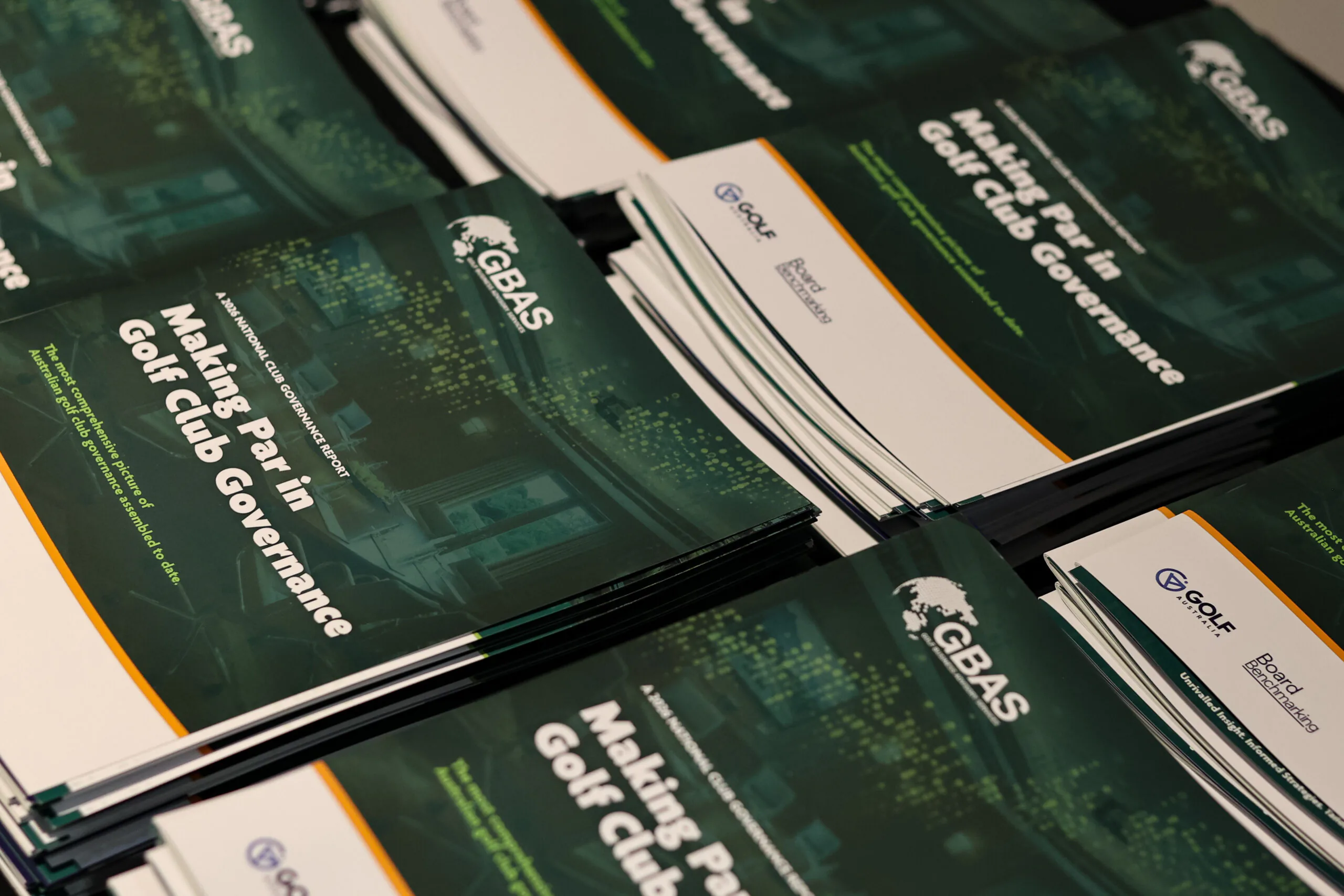
Board Benchmarking, part of the Insync Boards group of companies, has partnered with GBAS and Golf Australia to produce the most comprehensive study of Australian golf club governance ever conducted. The Australian Institute of Company Directors (AICD) supported the research with a foreword from its CEO and Managing Director.
Golf clubs are no longer small community operations run on goodwill and a folding table in the pro shop. Australia’s roughly 1,300 clubs serve more than 477,000 members, and the top 150 alone manage close to $900 million in revenue and $2.4 billion in assets. Running that scale of enterprise on a volunteer board is a genuinely hard governance problem, and the newly released Making Par in Golf Club Governance report shows the industry is still working through it.
The report is the third instalment of the National Club Governance Survey. This year’s edition is the largest yet: 1,139 respondents from over 600 clubs nationwide, spanning fully volunteer-run country clubs through to large metropolitan facilities with full executive teams. Of those, 922 full responses (636 directors and 281 club managers) form the basis of the analysis.
In his foreword, Golf Australia CEO James Sutherland frames the stakes plainly: golf is experiencing “a period of unprecedented growth, transformation and opportunity,” but that growth brings clubs “increasingly complex issues including financial sustainability, capital planning, workforce and volunteer management, inclusion, member expectations, risk and regulatory compliance.” Supporting clubs through that shift is why Golf Australia partnered with the AICD on the Golf Australia Club Governance Program, and why this survey now sits inside a broader industry effort, BIG SWINGS 2026 to 2030, to make governance a source of strength rather than a compliance burden.
AICD Managing Director and CEO Mark Rigotti makes a similar point from the director-education side of the table. In his foreword, he describes governance as fundamentally “how decisions are made, how accountability is exercised, and how organisations remain sustainable and focused on their purpose over the long term,” and notes that golf illustrates the scale of the challenge: more than four million Australians engaged with the sport last year, across an industry worth over $10 billion annually. Rigotti’s central theme, clarity of purpose, strategy and roles, turns out to be exactly where the survey data lands hardest.
The most consequential number in the report isn’t any single governance score. It’s the gap between two of them. Eighty percent of directors rate their board as effective. Only 70% of managers agree. That ten-point perception gap has shown up in every year of this research, and it’s most pronounced on role clarity, director behaviour and long-term planning. The report’s authors argue this is the real risk: boards that overestimate their own effectiveness have less reason to change, and the people best placed to see the gap, GMs and club managers, are the ones absorbing the cost of it.
For the third consecutive year, role clarity is the lowest-scoring dimension in the survey, sitting in the bottom quartile against Board Benchmarking’s broader not-for-profit database. Only 57% of respondents agree that directors clearly understand where their role ends and management’s begins, and the director/manager split here is the widest of any question in the survey (61% vs 49%).
The practical consequence shows up in how boards actually spend their time. Forty-four percent of respondents describe their board as operations-focused rather than strategic, rising to 51% among fully volunteer-run clubs. GMs report that director overreach into day-to-day operations is the single most frequently raised governance complaint across all three years of the research, not a one-off frustration, but a structural pattern.
Board capability is the second constraint. While 63% of respondents believe their board has the right mix of skills, that still leaves more than a third of clubs with capability gaps, compounded by low gender diversity (women make up only 20% of respondents) and election processes still driven more by availability or popularity than by a deliberate skills match.
Interpersonal governance (the chair-GM relationship, board-management relationships and overall teamwork) is where clubs perform best, scoring in the middle quartiles of the not-for-profit benchmark. But that collegiality doesn’t extend to accountability. Only 65% of respondents believe director conduct issues are handled appropriately, and boards consistently rate themselves more comfortable with this than managers do. Good relationships, in other words, aren’t the same thing as a board willing to have a hard conversation with one of its own.
Long-term and capital planning rounds out the picture, and shows one of the largest perception gaps in the survey: 72% of directors believe their board actively governs long-term capital planning, versus only 60% of managers. With over half of clubs turning over less than $1 million a year and heavily dependent on volunteers, the report’s authors argue the issue isn’t just capability, it’s capacity.
The report doesn’t stop at diagnosis. It sets out five priority actions: clarifying and enforcing director roles, building board capability deliberately through skills-based recruitment, strengthening chair leadership and accountability, rebalancing board agendas toward strategy over operations, and embedding long-term and capital planning into ongoing governance. Each comes with separate, practical guidance for chairs and boards, for club managers, and for smaller volunteer-run clubs specifically, recognising that a fully volunteer-run country club and a metropolitan club with an executive team need different starting points, even if the underlying principles are the same.
For an industry managing billions of dollars in community assets largely through volunteer boards, the pattern here should be a familiar one to anyone working in member-based or not-for-profit governance more broadly: real strengths in relationships and commitment, sitting alongside structural gaps in role clarity, board composition and forward planning that don’t close on their own. Three years of consistent data removes any excuse for treating these as one-off findings.
Board Benchmarking’s research and benchmarking capability sits within the Insync Boards group, alongside our broader board governance advisory services. The full report, including the detailed data tables by club size, structure, location and gender, and the complete set of practical actions for chairs, boards and managers, is available to download now.
Enter your details to have a copy of the report sent to your email.
"*" indicates required fields



Board Benchmarking
Australia
Level 27, 367 Collins Street
Melbourne, Victoria 3000
PH: +61 3 9909 9295
Westlake Governance
New Zealand
PO Box 8052
Wellington 6140
New Zealand
PH: +64 21 443 137
Halex Consulting
United Kingdom
86-90 Paul Street London, EC2A 4NE
PH: +44 (0)20 3823 6569
Cornerstone
India
313 Gokul Arcade
Subhash Road,
Vile Parle East
Mumbai, 400057
PH: +91 981 907 7135
Peakstone Global
Australia
GPO Box 1486
Brisbane Queensland 4001
PH: 1300 860 450
Board Benchmarking
Malaysia
66 Jalan Ibrahim Johor Bahru
80000 Johor
PH: +60 1933 54731
BDO
Mauritius
10 Frère Félix de Valois
Port Louis
PH: +230 202 3000
Gaines Advisory
Australia
PO Box 610
Cottesloe WA 6011
PH: +61 414 633 230
BDO
Malaysia
360 Jalan Tuanku Abdul
Rahman
50100 Kuala Lumpur
PH: +603 2616 2888
Twafiika Consultants
Africa
20 Eugmbo Street
Windhoek
Namibia
PH: +264 81 287 2104